TL;DR: Thickness is not the same as quality or firmness — what’s inside the mattress matters far more than how tall it is. As a rough guide: 8″ suits children, guest rooms and lighter sleepers; 10″ is the most versatile choice for most Singapore adults; 12″+ suits heavier sleepers, couples with different body weights, and anyone wanting a plush pillow-top feel. Always check total bed height against your frame before buying.
Mattress thickness is one of the easiest specifications to see and one of the easiest to misread.
Thicker looks more substantial. It photographs better. It feels more premium in a showroom. And it genuinely does matter — but not in the way most buyers assume, and not nearly as much as what’s inside.
Here’s how to actually use the number.
What mattress thickness is made of
Every mattress is a stack, and the total height is the sum of two things:
The support core — the spring unit or high-density base foam. This does the structural work: holding your spine in alignment and carrying your weight. It’s typically the largest portion of the total thickness.
The comfort layers — foam, latex, gel or fibre sitting above the core. These handle pressure relief and surface feel.
Two 10-inch mattresses can perform completely differently depending on how that 10 inches is split. One with an 8-inch core and 2 inches of comfort layer will feel firm and supportive. One with a 5-inch core and 5 inches of soft foam will feel plush and, for a heavier sleeper, under-supported.
So the useful question is never “how thick?” — it’s “how is the thickness divided?”
8-inch mattresses: when they’re the right choice
An 8-inch mattress is a legitimate, well-engineered product — not a compromise, provided it’s matched to the right sleeper.
Best suited to:
- Children and teenagers, whose lower body weight doesn’t require deep support layers
- Guest rooms and occasional-use beds
- Lighter adults, roughly under 60kg, who don’t compress deeply into a mattress
- Bunk beds and pull-out beds, where a thickness limit is often specified for safety or mechanism clearance
- Storage bed frames where a lower total height makes the lift mechanism easier to operate
Where 8 inches struggles: heavier sleepers and couples. With less material between you and the base, a heavier body can compress through the comfort layers and feel the support core — described by customers as the mattress “bottoming out.”
Also read: Best Pull Out Bed for Guests at Home
10-inch mattresses: the versatile default
If you asked us to recommend one thickness for a typical Singapore adult bedroom without knowing anything else, it would be 10 inches.
Why it works for most people:
- Enough depth for a proper spring or foam support core plus meaningful comfort layers
- Suits the broad middle of body weights, roughly 55kg to 90kg
- Works with the widest range of bed frames without creating awkward total heights
- Standard fitted sheets fit without straining
This is the thickness where you’ll also find the most product choice across pocketed spring, foam and hybrid constructions — which matters, because construction type affects your sleep more than an inch either way.
12-inch and thicker: when the extra depth earns its place
Genuinely beneficial for:
- Heavier sleepers, roughly 90kg and above. More material means more compression distance before you reach the core, and better sustained support.
- Couples with a significant weight difference. Deeper comfort layers with a good pocketed spring unit handle two different body weights on one surface better than a thin mattress can.
- Side sleepers with pressure point issues. Thicker comfort layers let hips and shoulders sink appropriately without the spine dropping out of line.
- Anyone wanting a pillow-top or hotel feel. That plush upper layer needs physical depth to exist.
Also read: What Mattress for a Heavy Person Offers Support? Also read: Hotel Mattress Singapore: How to Get That 5-Star Bed at Home (link once published)
The practical trade-offs: thicker mattresses are heavier, which makes rotating them a two-person job and makes them harder to manoeuvre through Singapore’s tighter corridors and lift lobbies. They also need deep-pocket fitted sheets — standard sheets will pop off corners.
The height calculation everyone forgets
This is the most common regret we hear, and it’s entirely avoidable.
Total bed height = bed frame height + mattress thickness.
The comfortable range for most people is a total height where, sitting on the edge of the bed, your feet rest flat on the floor with knees at roughly a right angle. For most adults that’s somewhere around 55cm to 65cm to the top of the mattress.
Run the sum before you buy:
- A tall divan bed frame plus a 12-inch mattress can produce a bed you have to climb into.
- A low platform bed frame plus an 8-inch mattress can sit uncomfortably low for older family members or anyone with knee issues.
Two Singapore-specific checks:
- Storage bed frames: a very thick mattress adds weight to the lift mechanism and can make daily use tiring. Check the mattress weight limit for the mechanism.
- Bunk beds and hidden wall beds: these almost always specify a maximum mattress thickness, for guardrail safety on bunks and for closing clearance on wall beds. Never exceed it.
Also read: Is a Hidden Wall Bed Singapore Right for You?
Does thicker mean firmer or softer?
Neither. Thickness and firmness are independent properties.
A 12-inch mattress with a firm core and thin comfort layers will feel firm. A 12-inch mattress with soft foam layers will feel plush. An 8-inch mattress can be either.
If a salesperson equates thickness with firmness, that’s a reason to ask more questions.
Thickness and Singapore’s climate
One consideration that doesn’t apply everywhere: thicker foam layers can trap more heat.
If you’re going for a thick foam or memory foam mattress here, look for gel infusion, open-cell foam, or a hybrid construction where air moves through a spring layer. A thick, dense all-foam mattress can sleep noticeably warm on a humid night, and no amount of good support compensates for that.
Hybrid constructions manage this well — you get the depth without losing airflow.
Quick reference
| 8 inch | 10 inch | 12 inch+ | |
| Best for | Children, guest rooms, lighter adults | Most adults, couples of average build | Heavier sleepers, plush feel |
| Rough weight range | Under ~60kg | ~55–90kg | ~90kg+ |
| Bunk / wall bed | Usually suitable | Check the limit | Usually too thick |
| Storage bed lift | Easiest | Fine | Check weight limit |
| Sheets | Standard | Standard | Deep-pocket needed |
Use it as a starting point, not a rule. Body weight, sleep position and construction all shift the answer.
Come and feel the difference
Thickness is genuinely hard to judge from a spec sheet — a 10-inch pocketed spring and a 10-inch foam mattress feel nothing alike.
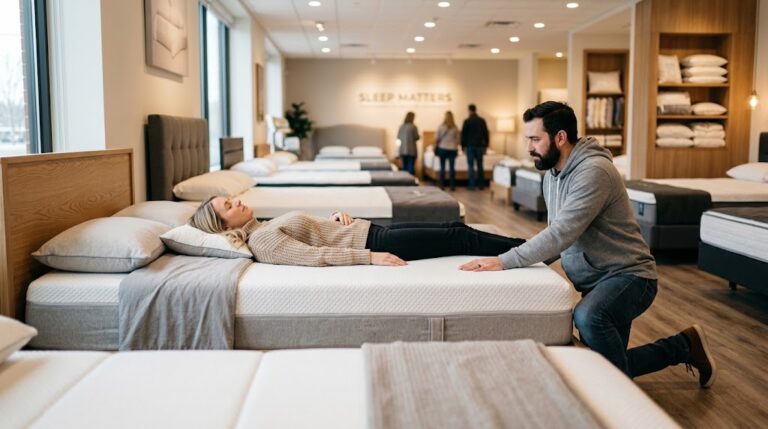
At the Catnap Lair furniture showroom at 33 Ubi Avenue 3, Vertex, #01-16, you can lie on different thicknesses and constructions side by side, and we can check the total bed height against whichever frame you’re considering before you commit.
Browse the full mattress range and bed frames, or plan a showroom visit.
Frequently Asked Questions
Is a thicker mattress better? Not automatically. What’s inside — the spring system, foam density and how the thickness is divided between support core and comfort layers — matters far more than total height.
What mattress thickness is best in Singapore? Ten inches suits most adults and offers the widest product choice. Lighter sleepers and children do well with 8 inches; heavier sleepers and those wanting a pillow-top feel benefit from 12 inches or more.
Does mattress thickness affect firmness? No. Thickness and firmness are independent. A thick mattress can be firm or plush depending on the materials and how the layers are arranged.
What thickness do I need for a storage bed frame? Check the mechanism’s weight limit. Thicker mattresses are heavier and can make a lift-up base harder to operate daily. Eight to ten inches is usually the easier range.
Can I use a 12-inch mattress on a bunk bed? Usually not. Bunk beds specify a maximum mattress thickness so the guardrail stays high enough to be safe. Always follow the manufacturer’s stated limit.
Do thick mattresses sleep hotter in Singapore? They can, particularly all-foam constructions. Look for gel-infused or open-cell foam, or a hybrid design where air moves through the spring layer.