In short: HDB does not publish standard lift dimensions, and any article telling you “the typical HDB lift is X by Y” is making it up. Lifts vary by block and by era. The only reliable number is the one you measure yourself, and the five minutes it takes will save you a cancelled delivery.
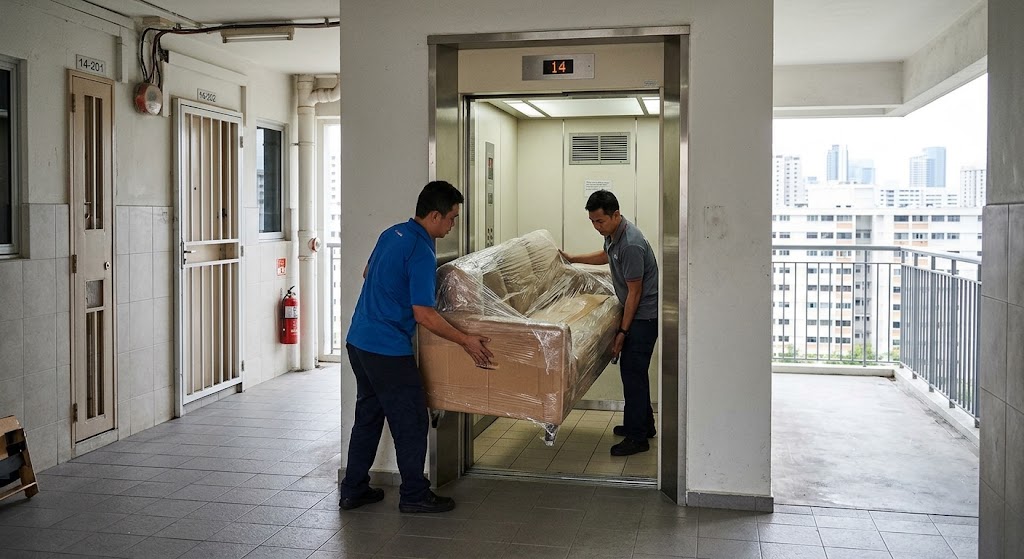
The sofa arrives. The delivery team measures the lift, looks at the box, and tells you it is not going up.
Now you are choosing between a carry up eleven flights, a rescheduled delivery with a restocking fee, or a refund and starting again. All of it avoidable with a tape measure and five minutes, three weeks earlier.
This guide covers what to measure, what the published rules actually say, which furniture causes the problem, and what your options are if it genuinely will not fit.
First, an honest word about “standard” HDB lift sizes
Search this question and you will find confident figures. Treat them with suspicion.
HDB does not publish standard lift car dimensions. We looked, properly. The numbers circulating online do not trace back to HDB, BCA or any town council — they trace to content sites repeating each other.
What is published are regulatory minimums, and they are useful as a floor rather than a description:
| Published requirement | Figure |
| Minimum internal lift car, for lifts designated for wheelchair users (BCA Code on Accessibility, cl 4.9.2.1) | 1200mm wide × 1400mm deep |
| Minimum clear lift door opening (cl 4.9.3.1) | 900mm |
| Minimum clear escape passage along an HDB common corridor (SCDF) | 1.2m |
| Minimum clear opening for an accessible doorway (cl 4.4.2.1) | 850mm |
Sources: the BCA Code on Accessibility and SCDF’s fire safety guidelines for residential estates.
Your lift is probably larger than the minimum. But “probably” is not a basis for ordering a three-seater sofa.
And some are genuinely small. In a 2015 parliamentary answer, the Ministry of National Development said about 15% of lifts in HDB residential blocks could take a wheelchair but not an ambulance stretcher in an inclined position. In October 2025, MND explained that smaller-capacity lifts were installed under the earlier Lift Upgrading Programme in low-rise blocks with few units — so the small ones are not simply “old blocks”, they are retrofits in particular kinds of block.
If you live in one of them, you will want to know before the lorry arrives.
What to measure, and how
Take a tape measure downstairs. Five measurements, written on your phone.
1. The lift door opening — width. Measure the clear opening with the doors fully open, edge to edge. This is usually the binding constraint, not the car itself.
2. The lift car — width and depth. Inside, wall to wall. Note anything that intrudes: handrails, mirrors, a protective blanket.
3. The lift car — height. This matters more than people expect. A tall item that will not fit flat can sometimes go up diagonally, and diagonal clearance depends on ceiling height. Note the ceiling fittings too.
4. Your flat’s main door opening. Clear width with the door fully open. Also check what the door opens into — a wall a metre away limits what you can angle through.
5. The tightest turn on the route. From the lift to your door, and from your door to the room. Corridor corners and the turn into a bedroom are where long items stop.
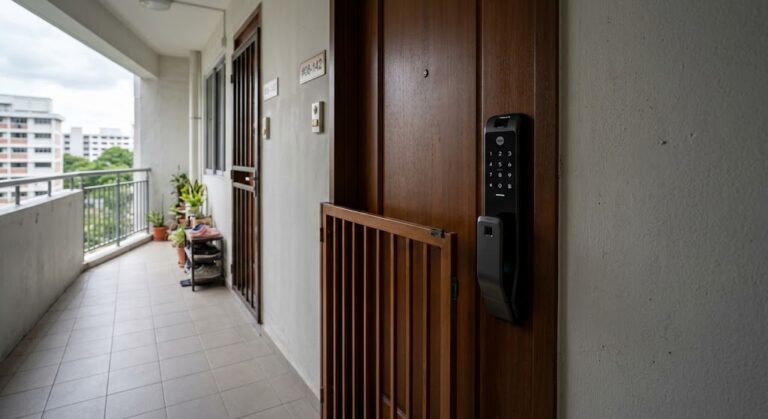
Two things people forget. Measure the packaged size, not the product size — boxing adds several centimetres each way, and most items are delivered boxed. And check whether your corridor is clear: shoe racks, plant stands and bicycles all reduce the width you actually have. SCDF requires a 1.2m clear escape passage along common corridors, which is also roughly what a delivery team needs.
The furniture that causes most of the trouble
Divan and storage bed bases. In our experience this is the single item that most often stops a delivery. A mattress is flexible and a slatted frame comes apart, but a divan or storage base is one rigid piece — it cannot be angled, folded or dismantled on the landing. Singapore bed sizes are standardised, which at least makes the maths easy:
| Size | Dimensions |
| Single | 91 × 190cm |
| Super Single | 107 × 190cm |
| Queen | 152 × 190cm |
| King | approximately 182–183 × 190cm |
Both Sealy and Simmons quote a manufacturing tolerance of around ±2cm, so treat these as close rather than exact.
The 190cm length is what matters. It exceeds the depth of many lift cars, which means the base goes in diagonally or on its end — and whether that works depends on the car height you measured.
Three-seater and L-shaped sofas. Long, rigid and heavy. Some models have detachable legs or a modular build that solves the problem entirely; some do not. It is worth asking before you order rather than after.
Tall wardrobes. Often fine in the lift and a problem at the bedroom door, particularly where a corridor turn limits how much you can tilt.
Dining tables with fixed tops. Stone and sintered-stone tops are both heavy and non-flexible, and cannot be stood on edge safely in the way a wooden top can.
What happens if it will not fit
Carry up the stairs. Most retailers offer it for a fee and cap how far they will go. Castlery, as one published example, charges S$10 per item per non-lift-accessible level, caps it at three flights, and may decline items over 80kg.
Dismantle and reassemble. Depends entirely on the product. Worth asking at the point of order, because the answer should be in the specification rather than discovered on the day.
Change the item. Not a defeat. A modular sofa, a bed frame that knocks down, or a slightly smaller size is usually a better outcome than a heroic stairwell operation.
Hoisting or a crane. Occasionally mentioned, rarely practical for household furniture. There is no published HDB or town council policy either permitting or prohibiting it, external lifting may require permits where a public road is obstructed, and the cost is not trivial. Treat it as a last resort for genuinely exceptional items.
The one to avoid: rescheduling on the day. This is where it gets expensive. Castlery’s published terms include a restocking fee where an order has to be rescheduled because of access problems, and most retailers have something similar — because it is explicitly the customer’s responsibility to confirm that items fit through doorways, staircases and lifts in their packaging before ordering.
If you live in a condo
Different problem. The lift is usually larger, but the process has more steps.
Most developments require a booking form submitted to management a few days in advance, a refundable deposit against damage, and restrict moving to weekday working hours — commonly Monday to Friday, with weekends treated as blackout days. Some permit Saturday mornings. Vehicle height limits for basement car parks are also common.
None of this is statutory. It is set per MCST, so check your own building’s house rules rather than assuming your neighbour’s experience applies.
How we handle it
This is most of why we would rather you came to the showroom than ordered from a photograph.
We deliver and install with our own team rather than handing off to a courier, which means access gets checked before the delivery date instead of discovered on it. If you tell us your block and floor when you order, we can flag the likely problems while you can still change your mind about a model.
If you are furnishing a smaller flat, our guide to choosing a sofa for a small living room covers the sizing side. For the pieces that most often cause access problems, it is worth seeing the construction in person — which sofas have removable legs, which storage bed frames come apart, how a wardrobe is assembled.
Before you order anything large, send us two things: your block and floor, and the five measurements above. We will tell you straight whether the piece you want goes up, and if it does not, which model in the same style does.
That check takes us a few minutes and costs you nothing. It is considerably cheaper than a restocking fee.
You can send it through the contact form, or bring your measurements to the Ubi showroom — 33 Ubi Ave 3, Vertex #01-16, open daily 11am to 8pm. Occasionally the answer is no, and it is much better to hear that standing in front of the sofa than standing in your corridor.
Frequently Asked Questions
What size is a standard HDB lift?
There is no published standard. HDB does not release lift car dimensions, and they vary by block and by the era of construction. Building regulations require at least one lift in a building to have a minimum internal car of 1200mm × 1400mm with a 900mm clear door opening, but most lifts are larger. Measure your own.
Will a king-size bed fit in my HDB lift?
A king mattress is roughly 182–183cm × 190cm and is flexible enough to manage most lifts. The base is the problem — a divan or storage base is typically one rigid piece at the full 190cm length, which exceeds the depth of many lift cars. Measure the car depth and height before ordering.
What do I do if my sofa cannot fit in the lift?
Options are a staircase carry for a fee, dismantling if the product allows it, or changing to a modular or smaller model. Rescheduling on the day is the expensive option, as most retailers charge a restocking fee when access was not checked beforehand.
Should I measure the product or the box?
The box. Most furniture is delivered packaged, and boxing adds several centimetres in each direction. Ask the retailer for packaged dimensions rather than product dimensions.
Do condo lifts need to be booked for a delivery?
Usually yes. Most developments require a booking form a few days in advance, a refundable deposit, and restrict moving to weekday working hours. The rules are set by each MCST rather than by law, so check your own building’s.
Can furniture be hoisted through a window in Singapore?
It is occasionally done for exceptional items, but it is not a routine option. There is no published HDB policy on it, external lifting equipment may need permits where a public road is affected, and the cost makes it impractical for ordinary furniture.