In short: Paint is cheaper to start and easier to touch up. Wallpaper covers wall imperfections, offers texture and pattern that paint cannot, and in Singapore’s climate it usually lasts longer than people expect — provided the wall behind it is dry. The deciding question is not cost. It is whether the wall has a damp problem, and whether you want to be able to repair one small patch later.
Most people ask this question the wrong way round. They compare the two quotes, pick the cheaper one, and discover the real difference two years later.
The useful comparison is not what each costs on the day. It is how each behaves over the years you will live with it — in a climate that is unkind to wall finishes, in a flat where you will inevitably scuff something, and under lighting that shows up every flaw in a badly prepared wall.
Here is how the two actually differ.
What wallpaper does that paint cannot
It hides a bad wall. This matters more in Singapore than homeowners expect. Older resale flats often have walls with hairline cracks, patched hacking lines, or a slightly uneven skim coat from a previous renovation. Paint shows all of it, especially in a room with a window down one side — low afternoon light will find every ripple. A textured wallpaper swallows the lot.
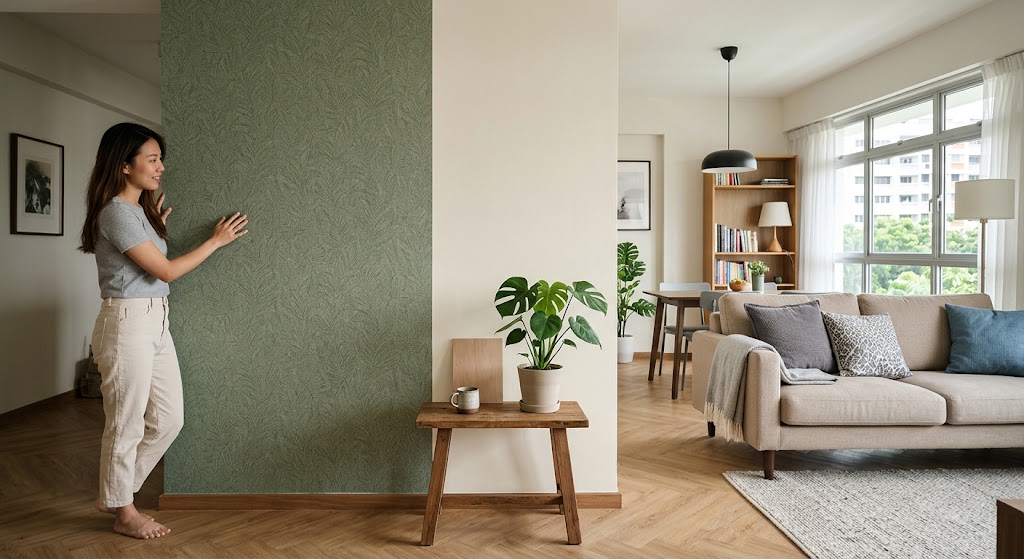
It provides depth. There is a limit to what a flat colour can do to a room. Fabric weaves, linen textures, subtle stone and concrete effects, wood grain — these change how a wall reads under light in a way no paint finish replicates. In a BTO where every room is a white box, one textured feature wall often does more for the space than repainting all four.
It is consistent. Paint applied by two different people, or by the same person on two different days, will not always match. Wallpaper comes off the same roll.
What paint does that wallpaper cannot
It is repairable in five minutes. This is paint’s real advantage and it is not a small one. A chair scuffs the wall, a child draws on it, you move a bookshelf and take a chunk out of the surface — you touch it up with the leftover tin. Wallpaper damage means replacing a panel, and unless you kept offcuts from the original batch, the replacement may not match exactly.
It is reversible. Changing your mind about a paint colour costs a weekend. Changing your mind about wallpaper means stripping it first.
It tells you when a wall is wet. If a wall has a genuine moisture problem — a shared wall with a bathroom, a leak from the unit above, damp coming through an external wall — paint will blister and flake. That is unpleasant, but it is visible. Wallpaper can conceal the same problem while it quietly gets worse underneath.
The Singapore question: does wallpaper survive the humidity?
This is the concern that stops most people, and the honest answer is: yes on a dry wall, no on a wet one.
Singapore’s relative humidity stays high all year and higher still through the monsoon months. Ambient humidity alone, though, is not what lifts wallpaper. Modern vinyl and PVC-based wallpapers — including the Korean wallpapers common in Singapore homes — are not paper in the traditional sense and do not absorb room moisture the way old paper-backed wallcoverings did.
What causes failure is moisture coming through the wall from behind. Three situations account for most of it:
- A wall backing onto a bathroom or kitchen wet area, where water is migrating through the masonry
- An external wall with a façade or window-seal problem, letting rain in
- Aircon condensation, where a unit drips or the pipe sweats onto the wall below
In all three the wall is the problem, not the wallpaper. Fix the source first. Wallpapering over a damp wall is how you turn a visible problem into a hidden one, and mould trapped between wall and covering is considerably worse than a patch of peeling paint.
A rough test before you commit: press your palm flat against the wall for thirty seconds. If it feels cold and slightly damp compared with the wall opposite, investigate before you cover anything.
Where each one wins, room by room
| Room | Better choice | Why |
| Master bedroom feature wall | Wallpaper | Texture reads well behind a bed; low wear; no water |
| Children’s bedroom | Paint | Repairability matters more than looks here |
| Living room feature wall | Wallpaper | Large uninterrupted surface, high visual payoff |
| Living room remaining walls | Paint | Wrapping a whole room in pattern is usually too much |
| Kitchen | Paint | Grease, heat, frequent wiping |
| Bathroom | Neither | Tiles |
| Hallway and corridor | Paint | Constant knocks from bags, trolleys, furniture |
| Study or home office | Wallpaper | Low wear, and texture behind you on video calls beats a blank wall |
Cost: the comparison people get wrong
Paint is cheaper to apply. That is not in dispute, and anyone telling you otherwise is selling wallpaper.
But the comparison people make is one paint job against one wallpaper job, and that is not the comparison they will live. Painted walls in a Singapore flat typically need refreshing well before wallpaper needs replacing, and each refresh means moving the furniture out, masking the floor and losing the room for two days.
If you are doing a whole flat, paint wins comfortably. If you are treating one or two feature walls and intend to leave them alone for years, the gap narrows once you count the repaints you will not be doing.
Neither is expensive enough that cost should decide a single wall. Choose on how the wall will be used.
Three practical points before you decide
Wall preparation is not optional for either. Wallpaper hides minor imperfections, not loose or flaking surfaces. If the existing paint is peeling, it has to come off first — wallpaper applied over a failing surface will take that surface with it when it lifts.
Check what you are allowed to do. Painting and wallpapering the interior of an HDB flat are cosmetic works and do not need a permit. Hacking, wall removal and works affecting the structure do. If your wall treatment is part of a larger renovation, confirm the whole scope against the current HDB renovation guidelines before the contractor starts.
Keep the offcuts. The single most useful thing you can do on wallpaper day. One spare roll, or even half a metre, turns a future repair from a mismatched panel into a ten-minute fix. Label it with the room and the date and put it on top of the wardrobe.
If you go with wallpaper
Installation quality decides how long it lasts. Seams butted properly disappear; seams that are not will be the only thing you see. Edges around windows, sockets and ceiling lines are where amateur jobs give themselves away.
We stock over 90 colours and textures of Korean wallpaper, and we supply and install rather than drop off rolls — partly because the installation is most of the outcome. Our wallpaper installation guide covers what the process involves and how long a room takes, and if you are still deciding what you want, our interior ideas post shows how different textures read in real Singapore flats.
Come and see the textures in person. Wallpaper under showroom lighting and wallpaper on your own wall at 6pm are different things, and a photograph tells you nothing about how a weave catches light. Hold a few against each other at the Ubi showroom — 33 Ubi Ave 3, Vertex #01-16, open daily 11am to 8pm.
Not sure whether your wall is suitable? Tell us which wall, which room and whether it backs onto a bathroom or an external face, and we will tell you honestly whether to wallpaper it or fix something first. We would rather talk you out of a wall that is going to fail than install on it.
Frequently Asked Questions
Is wallpaper a bad idea in Singapore’s humidity?
Not on a dry wall. Modern vinyl-based wallpapers, including Korean wallpaper, do not absorb ambient room moisture the way traditional paper-backed coverings did. Failures are almost always caused by moisture coming through the wall from behind — a wet area, a façade leak, or aircon condensation — rather than by humidity in the room.
How long does wallpaper last in an HDB flat?
On a dry, properly prepared wall with a competent installation, longer than most people expect, and typically longer than paint stays looking fresh. Poor wall preparation is the usual reason for early failure, not the material itself.
Can I wallpaper over existing paint?
Yes, if the paint is sound and well adhered. If it is flaking, chalky or peeling anywhere on that wall, it needs to come off first. Wallpaper will only bond as well as the surface underneath it.
Do I need HDB approval to wallpaper my flat?
No. Painting and wallpapering interior walls are cosmetic works and do not require a permit. Approval requirements apply to hacking, structural changes and certain other works — check the current HDB renovation guidelines if your wall treatment forms part of a bigger renovation.
Is wallpaper or paint better for a rented flat?
Paint, in most cases. Check your tenancy agreement first, as many require walls to be returned to their original condition. Removable options exist, but the landlord’s written agreement matters more than the product.
What happens if one section gets damaged?
With paint, you touch it up. With wallpaper, you replace a panel — straightforward if you kept offcuts from the original batch, frustrating if you did not. Dye lots vary between production runs, so a fresh roll of the same product may not match exactly.