TL;DR: The jump from budget to premium buys you real, measurable improvements — better spring systems, higher-density foam, longer warranties. The jump from premium to luxury buys you refinement: natural materials, hand-finishing, and marginal comfort gains. Most Singapore buyers get the majority of the benefit at the premium tier, not the luxury one.
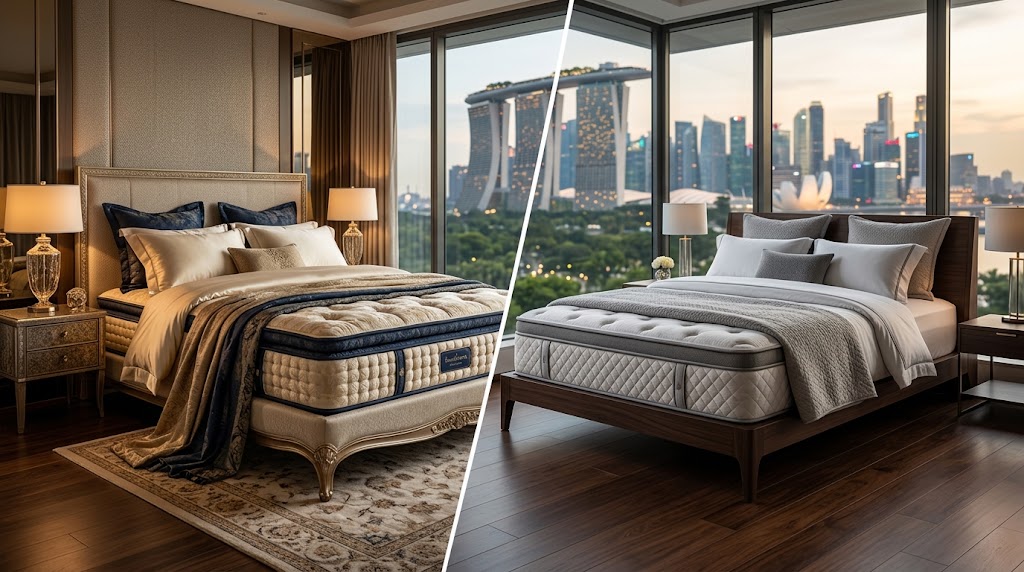
Two mattresses sit side by side in a showroom. They look nearly identical. One costs roughly twice the other. The salesperson explains the difference in a way that involves a lot of adjectives.
This post is the version of that conversation with the adjectives removed.
We sell across price tiers at our Ubi showroom, and we’d rather you understand what you’re paying for than simply spend more. Sometimes the more expensive mattress is genuinely the right call. Often it isn’t.
What actually changes as mattress price goes up?
Four things scale with price, in roughly this order of impact:
1. The spring system. This is where the biggest real-world difference lives. Cheaper mattresses use interconnected Bonnell springs — the whole unit moves together, so motion transfers and support is uniform rather than contoured. Move up and you get pocketed springs, where each coil is individually wrapped and responds independently. Move up again and you get higher coil counts, zoned support (firmer under the hips, softer under the shoulders), and reinforced perimeters.
2. Foam density. Two foam layers can look identical and behave completely differently. Low-density foam compresses permanently within a few years — that’s the body impression you eventually stop noticing. High-density foam holds its structure. This single factor drives more of a mattress’s lifespan than almost anything else, and it is invisible on a showroom floor.
3. Comfort layer materials. Basic polyfoam, then memory foam, then gel-infused or open-cell foams, then natural latex. Each step up generally improves either pressure relief, heat management, or both.
4. Construction quality. Edge support, cover fabric, stitching, and how well layers are bonded. Small individually, meaningful cumulatively over ten years.
The budget-to-premium jump: usually worth it
If you’re moving from an entry-level mattress to a premium one, you’re typically buying:
- Pocketed springs instead of Bonnell — better contouring, far less motion transfer
- Higher-density support foam — the mattress holds its shape for years longer
- A longer warranty — often 10 to 15 years instead of 3 to 5
- Better heat management — a genuine issue in Singapore, not a marketing feature
This is the price jump where you can actually feel and measure the return. A premium pocketed spring mattress that lasts twelve years at a higher price is cheaper per year than a budget mattress replaced twice in the same period — and you sleep better throughout.
Also read: Four Star Mattress Review Singapore: Is It Worth Buying?
The premium-to-luxury jump: it depends
Here’s where it gets more honest. Above the premium tier, you’re generally paying for:
- Natural materials — organic latex, natural wool, cotton, horsehair. Real benefits in breathability and sustainability, but not proportionally better spinal support.
- Hand-finished construction — hand-tufting, hand-stitched sides. Genuine craftsmanship, and it does affect longevity, though the gains are incremental.
- Very high coil counts and multi-layer spring systems — springs on springs. Refined feel, diminishing returns for most body types.
- Brand and heritage — a real part of luxury pricing, and worth naming plainly.
- Extended warranties, sometimes 20 to 25 years.
None of that is fake. But the comfort curve flattens. The difference between a $1,000 and $3,000 mattress is usually obvious in the first night. The difference between a $3,000 and $8,000 mattress is often subtle enough that buyers can’t reliably identify it in a blind test.
Who genuinely benefits from luxury tier: sleepers with specific material sensitivities who need natural fibres, people with pronounced pressure-point issues that standard foams don’t resolve, and buyers who simply value craftsmanship and can afford it without trade-offs elsewhere.
Who doesn’t: most people, most of the time.
What matters more than price in Singapore specifically
Two local factors override the tier conversation entirely.
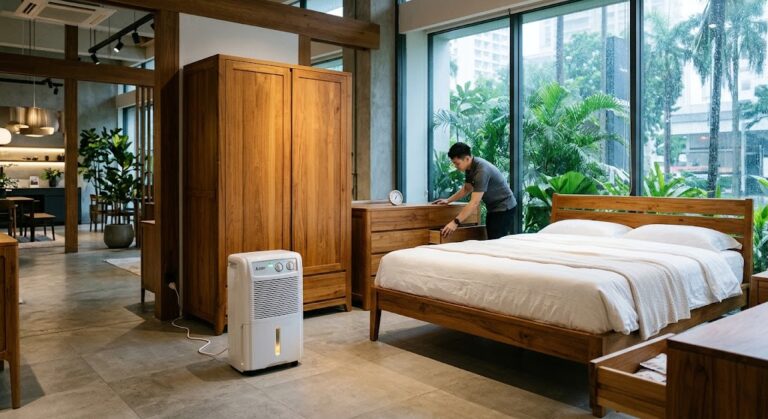
Heat and humidity. A luxury mattress with poor airflow will give you worse sleep in Singapore than a mid-tier mattress engineered for cooling. Dense memory foam in particular can trap body heat. Check breathability before you check price.
Bed frame compatibility. Putting an expensive mattress on a frame with wide slat gaps will void warranties and cause premature sagging. The frame is part of the system.
Also read: Chiropractic-Endorsed Mattress Singapore: What It Really Means — a useful check on how much weight to give endorsement labels at any price tier.
How to spot a mattress that’s overpriced for what it is
Ask these four questions. If the retailer can’t answer them, that tells you something.
- What is the spring system? “Pocketed spring” should come with a coil count and, ideally, whether it’s zoned.
- What is the foam density? Vague answers here are a red flag. Density is a number.
- What does the warranty actually cover? A 15-year warranty covering only manufacturing defects with a 3cm sag threshold is very different from one covering comfort degradation.
- What’s the trial or exchange policy?
A mattress carrying a big price with vague specifications and a thin warranty is priced on marketing, not construction.
Also read: What Does a 15-Year Mattress Warranty Actually Cover? (link to the warranty post once published)
Where direct factory pricing changes the maths
One thing worth flagging, because it complicates the tiers usefully: a lot of what you pay in retail furniture is distribution margin, not product.
At Catnap Lair we work on direct factory pricing with no middleman markup, which means a mattress that would sit at premium pricing through a conventional retail chain often lands at mid-tier pricing with us. The construction doesn’t change. The margin structure does.
That’s worth knowing before you decide your budget caps you at a certain tier — it may not.
Browse the full mattress range, including pocketed spring, hybrid, and latex constructions across price levels.
The practical recommendation
For most Singapore households: buy at the premium tier, and spend the money you saved on the bed frame, a proper protector, and good linens.
That combination outperforms a luxury mattress on a poor frame with worn-out bedding, and it costs less.
If you’re furnishing a whole home rather than replacing one mattress, our group buy programme applies bundle pricing across mattresses, bed frames and other furnishing — which can move you up a tier for the same total spend.
Also read: BTO Group Buy Furniture for a Better First Home
Come test the price gap yourself
The most useful thing you can do is lie on a mid-tier and a luxury mattress within ten minutes of each other and see whether you can tell.
Sometimes customers can, clearly, and they buy up. Often they can’t, and they buy the mid-tier with a clear conscience and a better bed frame. Both are good outcomes.
Visit the Catnap Lair showroom at 33 Ubi Avenue 3, Vertex, #01-16, or get in touch to arrange a visit.
Frequently Asked Questions
Is an expensive mattress really better in Singapore? Up to a point. The move from budget to premium delivers clear improvements in support, durability and heat management. Above premium, gains become incremental and depend heavily on individual sleep needs.
What’s the difference between a premium and a luxury mattress? Premium usually means pocketed springs, high-density foam and a 10–15 year warranty. Luxury adds natural materials, hand-finishing, very high coil counts and extended warranties — refinements rather than fundamental improvements.
How much should I spend on a mattress in Singapore? Rather than a fixed figure, aim for the tier where you get pocketed springs, verified high-density foam and at least a 10-year warranty. Direct factory pricing can put that within reach at a lower cost than conventional retail.
Do luxury mattresses last longer? Often yes, due to better materials and construction. But a well-built premium mattress on a proper bed frame with a protector can match or beat a luxury mattress that’s poorly supported and unprotected.
Is memory foam or pocketed spring better for Singapore’s climate? Pocketed spring and hybrid constructions generally sleep cooler because air moves through the coil layer. Dense memory foam can retain heat unless it’s gel-infused or open-cell.
Where can I compare mattress tiers in person in Singapore? The Catnap Lair showroom at Ubi carries brands across budget, mid and premium tiers at direct factory pricing, so you can compare construction and feel side by side before deciding.