

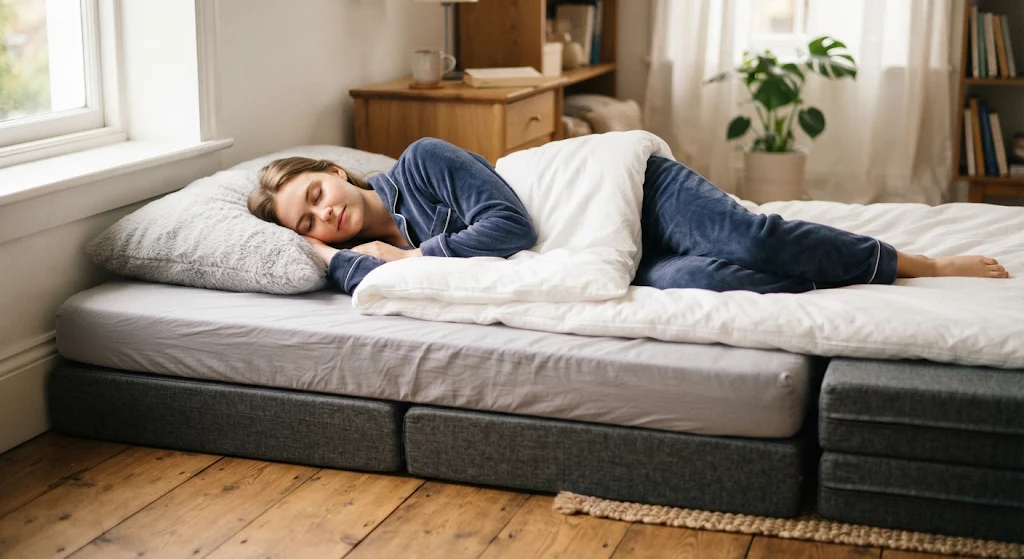
In short: Thickness decides it. Under 3 inches, a foldable mattress is fine for one night and uncomfortable by the third. At 4 inches and above, most adults sleep well on one. The fold line is the other thing to check — it is where the foam breaks down first, and it sits directly under your hips.
The honest version of this question is: comfortable for whom, and for how long?
A foldable mattress for a guest who stays twice a year is a different product from one somebody sleeps on every night in a small room. Both exist. Buying the first when you needed the second is the mistake we see most often.
Thickness is the whole answer
| Thickness | Realistic use |
|---|---|
| 2 inches | One night, occasional. A floor cushion more than a mattress |
| 3 inches | A weekend. Lighter adults manage longer |
| 4 inches | Regular guest use. Most adults sleep well |
| 5 inches and above | Nightly sleeping, including in a small bedroom |
The reason is simple physics. When you lie on your side, your hip carries most of your body weight through a small area. Thin foam compresses fully under that load and you end up resting on the floor through a layer of material.
Lighter sleepers get away with less. Anyone above average build should start at 4 inches and not negotiate downwards.
The fold line, and why it matters
A foldable mattress has one or more hinge points where the foam is scored or stitched so it bends. That line is the weakest part of the mattress, and it compresses faster than the sections either side.
Two things follow from that.
Check where the fold sits. A two-fold mattress has its hinge near the middle, which puts it under your hips — the heaviest part of your body. A three-fold design spreads the stress across two lines, which usually wears more evenly.
Rotate it. Turning the mattress end to end every couple of months moves the load around and delays the dip forming. Nobody does this with a guest mattress, which is why guest mattresses develop a valley across the middle.
Floor sleeping in a humid climate
Sleeping on the floor is common in Singapore homes, particularly for children and guests, and it brings a problem that a bed frame solves automatically.
With mean annual relative humidity around 82%, rising above 90% before dawn according to the Meteorological Service Singapore, the moisture your body releases overnight has nowhere to go when the mattress sits flat on a tiled floor. It collects on the underside. Left folded and stored damp, that becomes mould within weeks.
Two habits prevent it entirely: stand the mattress on its side for an hour after use before folding it, and store it somewhere with air movement rather than sealed in a cupboard or under a bed.
This is the single most common reason a guest mattress smells musty when it comes out six months later. It is not the mattress. It is how it was put away.
Where foldable mattresses genuinely work
Guest sleeping, occasionally. The original use case, and the one they do best.
A child’s room where floor space matters by day. Fold it, stack it against a wall, and the room becomes a play area.
A study or box room doubling as a spare bedroom. No permanent furniture needed.
A helper’s room. Where floor area is limited and the mattress needs to clear during the day.
Short-term rental or a new flat before the real bed arrives. Common during a BTO move-in gap.
Where they do not
If someone sleeps on it every night for years, buy a proper mattress. No foldable design matches a pocketed spring for support over that timeframe, and the fold line will eventually tell you so.
If guests stay often and you have the floor area, a pull-out bed is a better answer — it gives a proper sleeping surface that disappears under the main bed between uses. We cover the options in our pull-out bed guide.
And if the person sleeping on it has back problems, a thin foldable mattress on a hard floor is the wrong surface. That is a conversation for a doctor or physiotherapist rather than a furniture showroom.
Testing one properly
Lie on it on the floor, which is where it will be used — not on a slatted base where it behaves completely differently.
Give it five minutes on your side and pay attention to your hip. If you can feel the floor through it within that time, it is too thin for anything beyond one night. Then put a hand on the fold line and press: a well-made hinge compresses close to the same amount as the foam either side of it.
Our foldable mattresses sit alongside the full mattress range at 33 Ubi Ave 3, Vertex, #01-16, open daily 11am–8pm, so you can feel the difference between a guest-grade foam and something built for nightly use.
Tell us how often it will actually be used and who will sleep on it and we will tell you what thickness you need — and whether a foldable mattress is the right product at all.
Frequently asked questions
Are foldable mattresses comfortable enough to sleep on?
At 4 inches and above, yes, for most adults. Below 3 inches a foldable mattress is fine for one night and uncomfortable by the third, because the foam compresses fully under your hips and you end up resting on the floor through it. Heavier sleepers should start at 4 inches.
How thick should a foldable mattress be?
Two inches for occasional single-night use, three for a weekend, four or more for regular guest use, and five or more if someone sleeps on it nightly. Thickness matters more than any other specification on this type of mattress.
Do foldable mattresses go mouldy in Singapore?
They can, if folded and stored while still holding overnight moisture. With humidity above 90% before dawn, a mattress used on the floor absorbs moisture that has nowhere to escape. Stand it on its side for an hour before folding, and store it where air moves.
How long does a foldable mattress last?
Far less than a conventional mattress, and the fold line usually fails first. Rotating it end to end every couple of months spreads the load and delays the dip forming across the hinge. For nightly sleeping, a standard mattress is the better investment.
Is a foldable mattress or a pull-out bed better for guests?
A pull-out bed, if you have the floor space for the host bed. It gives a proper sleeping surface and stores out of sight. A foldable mattress wins where there is no room for a permanent frame, or where the sleeping space has to clear completely during the day.
Can you use a foldable mattress on a bed frame?
You can, but it changes how it feels. On slats the mattress flexes between the gaps, and the fold line can sit over a gap and sag. Foldable mattresses are designed for a flat, solid surface, which usually means the floor.


