

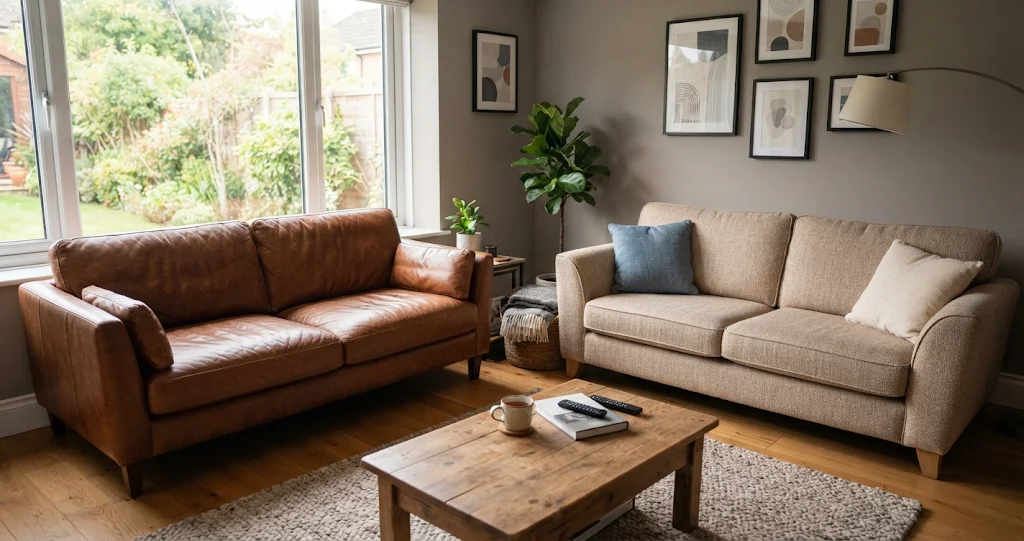
In short: Fabric is more forgiving in Singapore’s humidity and more comfortable against skin in a room without aircon. Full leather lasts longest and wipes clean, but needs airflow or it grows surface mould. Half leather is the one to understand before you buy — it is genuine leather only where your body touches it, and synthetic everywhere else.
The showroom version of this question is always the same: which one survives here?
Singapore is harder on upholstery than most climates. Mean annual relative humidity sits around 82%, climbing above 90% before sunrise, according to the Meteorological Service Singapore. Then we run aircon against it, which creates cold surfaces for that moisture to condense on. Upholstery sits in the middle of that cycle.
The three things you are actually choosing between
| Full leather | Half leather | Fabric | |
|---|---|---|---|
| What it is | Genuine hide on every surface | Genuine hide on contact surfaces, PU elsewhere | Woven textile over foam |
| Humidity | Needs airflow; can surface-mould | Same, plus the PU can peel over years | Absorbs and releases moisture |
| Spills | Wipes off if caught quickly | Wipes off on the leather sections | Soaks in unless treated |
| Against skin | Cool at first, sticks when warm | Same | Breathable, no sticking |
| Repairs | Can be reconditioned | Leather sections only | Covers often removable and washable |
| Ageing | Develops patina over years | Leather ages, PU degrades | Fades and pills |
What half leather actually means
This is the term that catches people out, and it is common in Singapore because it sits between the other two.
A half leather sofa uses genuine leather on the seat, the backrest and the armrests — the surfaces your body contacts — and polyurethane or bonded material on the sides and back. From the front, it looks identical to full leather.
That is not dishonest in itself. You are paying for leather where leather matters and not paying for it on panels nobody touches. The thing to know is how the two materials age at different rates: the leather sections develop patina and can be reconditioned, while PU has a finite life and eventually cracks or peels. After several years you can end up with a sofa whose front looks good and whose sides do not.
If a showroom will not tell you which panels are genuine, that answer is its own answer. Ask, and run a hand around the back.
How humidity treats each one
Leather does not absorb moisture the way fabric does, but it will grow surface mould in still, humid air. The pattern is always the same: a sofa pushed flat against an external wall in an air-conditioned living room, with no air moving behind it. Pull it 50mm off the wall and most of that risk disappears.
Vegetable-tanned leather also stiffens over time in prolonged warm, damp conditions. Keeping a leather sofa out of direct afternoon sun matters more here than in a temperate climate.
Fabric holds moisture in the foam beneath the cover, which is why a fabric sofa smells before it shows anything. The same 50mm gap applies, and removable covers are worth more in Singapore than anywhere else — being able to take a cover off and wash it solves a problem that is otherwise permanent.
Half leather inherits both sets of behaviour, split across the piece.
Aircon, skin and the thing nobody mentions
Leather is cool when you first sit on it and warm after twenty minutes. In a room without aircon, bare skin sticks to it. That is the single most common complaint we hear from customers who chose leather on looks.
Fabric breathes, so it stays closer to body temperature and does not stick. If your living room is only air-conditioned in the evenings, that difference is something you will feel every day.
Which one for which household
Young children. Fabric with removable, washable covers. Leather marks from pens and keys and cannot be laundered.
Pets. Fabric in a tight weave, or full leather. Claws pull loops in loose weaves and puncture PU, which is the weakest surface of the three for this.
No aircon in the living room. Fabric. Leather and bare skin in 82% humidity is not a combination you will enjoy.
Eating on the sofa. Leather or half leather on the contact surfaces. Oil goes straight into untreated fabric.
Long term, low maintenance. Full leather, with the airflow gap and occasional conditioning. It outlasts the other two by a wide margin if the conditions are right.
Checking it properly
Sit on it for five minutes, not five seconds. Leather feels cool on contact and that sensation disappears — how it feels after your body has warmed it is the real test.
Then do three things: run a hand around the back and sides to find where the material changes, press into the seat to feel whether the foam recovers or stays compressed, and lift a corner to see what the frame is made of.
Our sofa range is on the floor at 33 Ubi Ave 3, Vertex, #01-16, open daily 11am–8pm, and you can sit on fabric and leather side by side rather than deciding from photographs. If the room is tight, our guide to choosing a sofa for a small living room covers the sizing side.
Tell us which room it is for, whether it runs aircon and who uses it — children, pets, both — and we will tell you which material to rule out before you come in.
Frequently asked questions
Is a leather or fabric sofa better for Singapore?
Fabric is more forgiving in high humidity and more comfortable in a room without constant aircon. Leather lasts longer and wipes clean, but needs airflow behind it or it develops surface mould. The deciding factor is usually whether your living room runs aircon and whether children or pets use the sofa.
What is a half leather sofa?
A sofa with genuine leather on the contact surfaces — seat, backrest and armrests — and polyurethane or bonded material on the sides and back. It looks like full leather from the front. The leather sections age well; the synthetic ones have a finite life and eventually crack or peel.
Does leather furniture grow mould in Singapore?
It can, in still humid air with no airflow. Mould on leather is a surface problem that cleans off if caught early. The usual cause is a sofa pushed flat against an external wall in an air-conditioned room. Leaving 50mm behind it prevents most cases.
How long does a fabric sofa last in Singapore?
It depends far more on the foam and the frame than on the fabric. Covers fade and pill over time, and removable washable covers extend the usable life considerably. What ends a fabric sofa is usually foam that stops recovering, not the cover.
Which sofa material is best with young children?
Fabric with removable, washable covers. Spills and marks are inevitable, and a cover that goes in the machine solves what a wipe cannot. Avoid PU-heavy half leather, which punctures and peels under rough use.
Why does my leather sofa feel sticky?
Leather does not breathe, so it holds body heat and traps perspiration against the skin. The effect is strongest in a room without air conditioning, which is why fabric suits many Singapore living rooms better despite leather’s longer life.